
The Hidden Crisis After Rescue
Every rescue is a victory.
But freedom from exploitation is only the beginning.
Where does that child go to heal?
RESCUE IS A MOMENT. RESTORATION IS A JOURNEY.
A child can be removed from exploitation in a night. Healing cannot be rushed.
Children who have survived trafficking need far more than temporary shelter. They need medical care, trauma-informed mental-health support, education, protection from traffickers, healthy relationships, and years of patient, consistent care.
Rescue ends the immediate exploitation.
Restoration helps a child build a life beyond it.
Safe housing · Trauma-informed care · Medical support · Education · Trusted relationships
Why these needs matter: Federal child-welfare guidance specifically identifies safe housing, trauma-informed health and mental-health care, education, and reconnection with trustworthy adults among the needs of trafficked children. Child Welfare Information Gateway
The need is enormous.
The capacity is not.
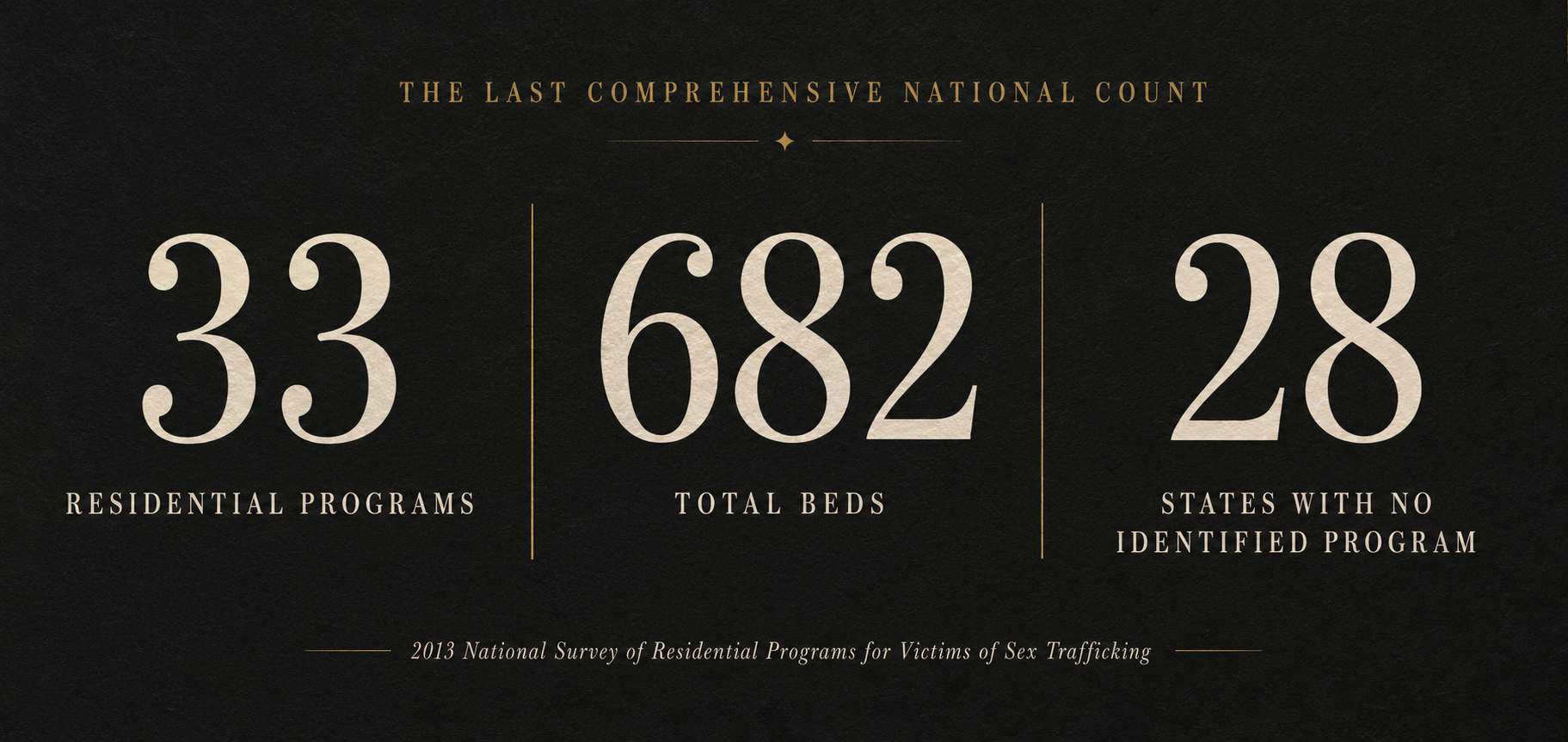
A national survey published in 2013 identified only 33 residential programs operating exclusively for trafficking survivors, providing 682 beds across 16 states and Washington, D.C.
Approximately 75% of those beds were designated for minors.
More than a decade later, no comparable national inventory has replaced that count.
Source: National Survey of Residential Programs for Victims of Sex Trafficking, 2013 U.S. Department of Justice
WHAT CURRENT DATA REVEALS
Children are still being identified. Yet no comparable national inventory tracks restoration capacity.
1 in 7
Of the more than 32,000 missing-child reports received by the National Center for Missing & Exploited Children in 2025, approximately one in seven involved a child considered likely to be a victim of child sex trafficking.
17%
Of children reported missing from child-welfare care in 2025, 17% were identified as likely victims of child sex trafficking.
These figures represent children reported to NCMEC—not the total prevalence of child trafficking in the United States.
Source: National Center for Missing & Exploited Children, 2025 data

WHEN THE RIGHT BED ISN’T AVAILABLE
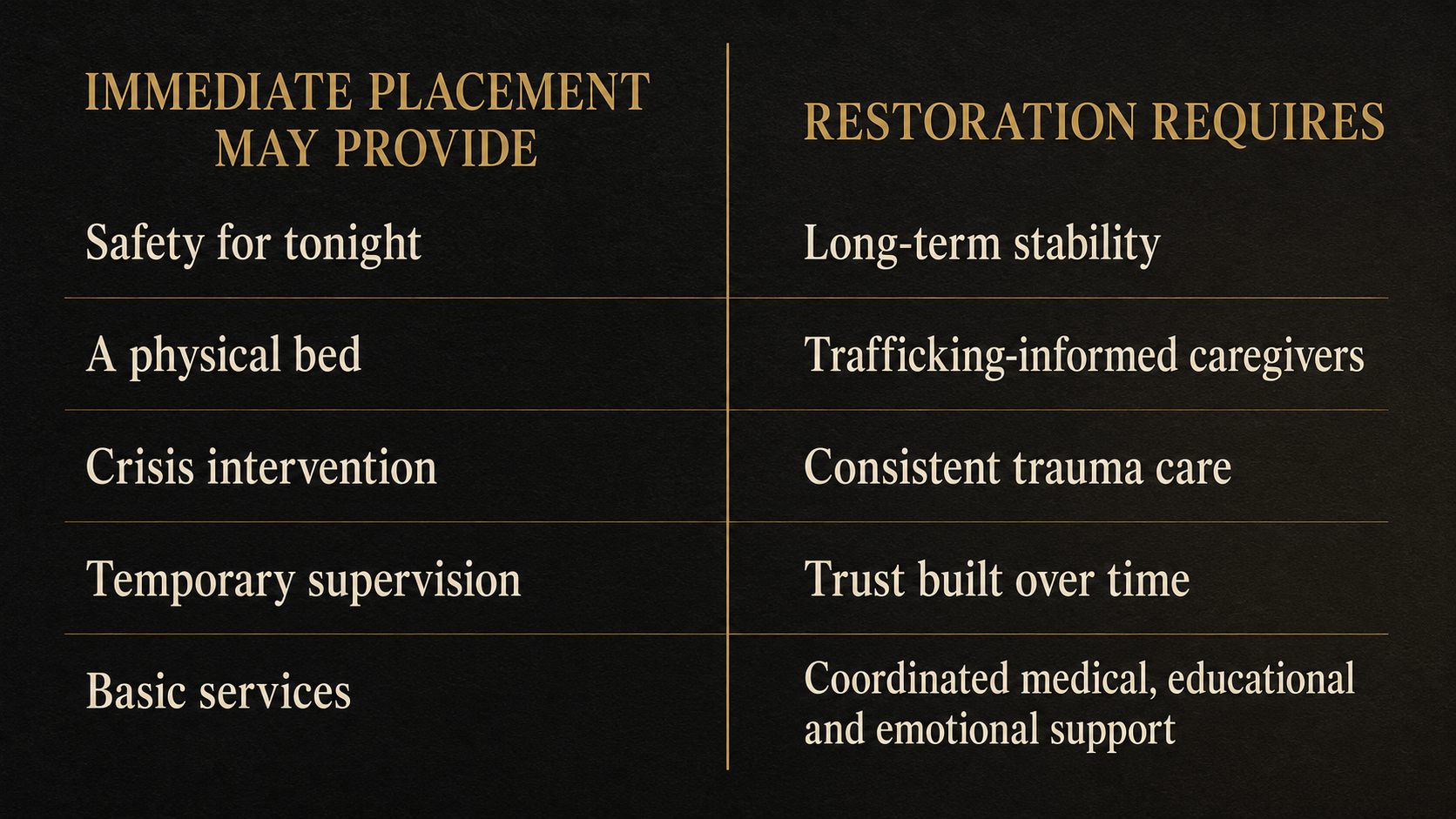
A child may be safe for tonight—and still have nowhere equipped to help them heal.
When specialized placements are unavailable, child-welfare agencies must work within the options they have: foster homes, group homes, congregate-care facilities, emergency shelters, or other temporary arrangements.
Many of these caregivers and programs do heroic work. But trafficking survivors can have needs that ordinary placements were never designed or staffed to address.
A place to stay is essential.
A place prepared for restoration is something more.
What this looks like in real life
In 2016, Dr. Kimberly Mehlman-Orozco documented what happened after she helped a woman leave trafficking but could not find an appropriate residential program. Despite numerous calls to service providers, the survivor moved between temporary settings and considered returning to her trafficker because he had provided a roof over her head.
Nearly a decade later, recent reporting shows that the restoration gap remains. Children—including trafficking survivors—have been housed in hotels and unlicensed temporary settings when appropriate placements could not be found.
Read Dr. Mehlman-Orozco’s account
Read the Texas Tribune investigation
Read the 2026 LifeWay survivor story
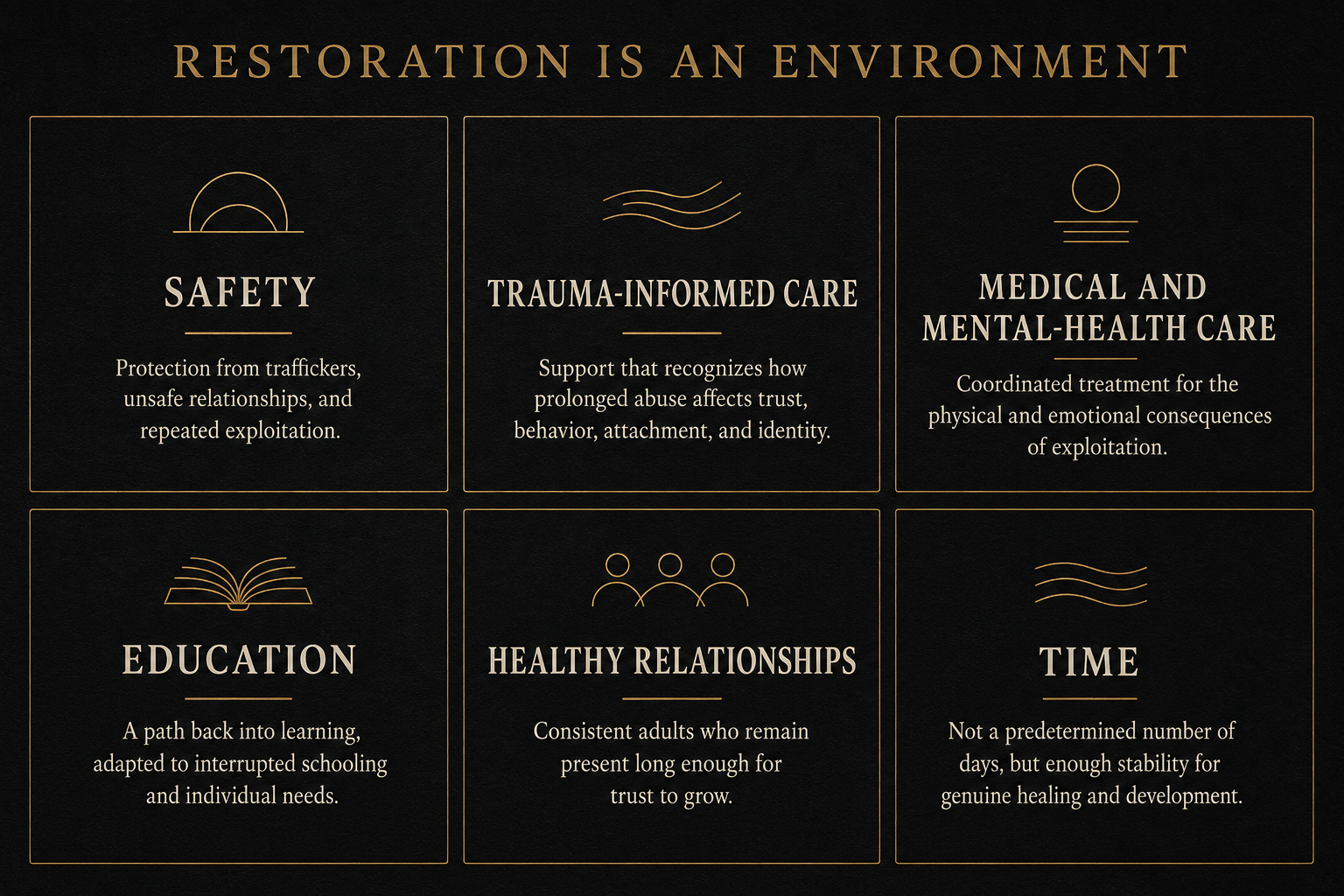
Restoration is not one service.
When these pieces are fragmented, children can fall through the gaps between rescue and recovery.
Research submitted to the Department of Justice has warned that waiting lists, shelter time limits, and inadequate housing resources can leave vulnerable youth at immediate risk of trafficking or re-exploitation. National Institute of Justice evaluation
Recent research confirms the need
Federal research and survivor-led data identify safe housing, trauma-informed services and long-term stability as essential—and document how shelter scarcity and restrictive placement policies leave survivors vulnerable.
HUD: Housing Needs of Survivors of Human Trafficking
Polaris: Housing Instability and Trafficking Survivors
NCTSN: Child Sex Trafficking Guidance
THE RESTORATION CRISIS
The shortage is not merely a shortage of beds.
It is a shortage of safe places, trained caregivers, coordinated services, and enough time for children to heal.
A child should not be rescued from exploitation only to discover there is nowhere prepared to receive them.
The evidence points to one conclusion:
Rescue capacity must be matched by restoration capacity.
Children need more than rescue. They need safe homes, trained caregivers, and years of support to rebuild their lives.
Every child deserves more than rescue. Every child deserves a place to heal.
The evidence is clear. Infrastructure is how we solve it.